sugar
4 Pack TEMT6000 Ambient Light Sensor Module – Visible Light Intensity Detector
4 Pack TEMT6000 Ambient Light Sensor Module – Visible Light Intensity Detector
Couldn't load pickup availability
Product Description
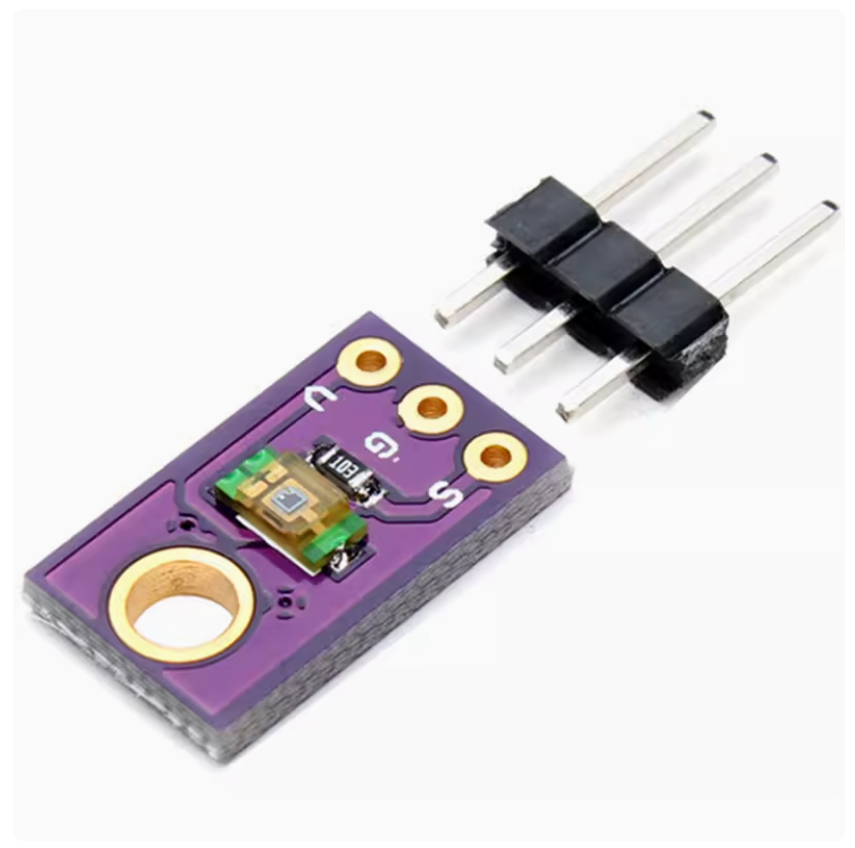
The TEMT6000 Environmental Light Sensor Module is a visible‑light detector that converts ambient light intensity into an analog voltage signal using a TEMT6000 NPN phototransistor and an on‑board resistor in a simple voltage‑divider circuit. Its spectral response closely matches that of the human eye, with peak sensitivity around 570 nm, making it well suited for applications like automatic backlight dimming, room‑light detection, and general brightness monitoring.
Designed for easy integration, the module exposes three pins (VCC, GND, SIG/OUT) and supports 3.3–5.5 V supplies, so it can connect directly to analog inputs on Arduino, ESP32, and similar controllers. It is most sensitive in indoor and shaded environments (roughly 1–1000 lux), giving useful relative brightness readings while ignoring most IR and UV, which simplifies many practical lighting applications.
Ideal Uses
- Automatic display and backlight dimming based on room brightness (dashboards, LCDs, control panels).
- Smart‑lighting and home‑automation projects that respond to daylight or occupancy lighting conditions.
- Ambient light logging for data‑logging nodes, weather stations, or building‑monitoring systems.
- Light‑responsive art, mood lighting, and interactive installations that change with environmental brightness.
- Educational projects demonstrating phototransistors, analog sensing, and lux conversion.
Compatibility
- Works with Arduino, ESP32, ESP8266, and similar microcontrollers by connecting the analog output to an ADC pin (SIG/OUT → analog input).
- Supports 3.3–5.5 V supply voltage, making it compatible with both 5 V Arduino boards and 3.3 V platforms like ESP32 and Raspberry Pi Pico.
- Can be used with ESPHome and other firmware that read analog sensors and optionally convert readings to approximate lux values using documented formulas.
- Suitable for indoor/light‑level detection rather than direct full‑sun measurements, as the sensor saturates at high lux levels.
Key Features
Human‑eye‑like spectral response with peak sensitivity at ~570 nm and primary sensitivity across ~440–800 nm visible range (limited IR/UV response).
Analog voltage output proportional to incident light; output range approximately 0–VCC (0–5 V at 5 V supply).
Uses TEMT6000 phototransistor configured in a voltage‑divider circuit on the breakout board for straightforward ADC measurements.
Wide angle of half sensitivity of about ±60°, allowing the sensor to capture ambient light from a broad field.
Typical illumination range for useful readings from about 1–1000 lux, ideal for indoor and shaded environments.
Low current consumption (around 20 mA typical), suitable for low‑power applications.
Small PCB footprint with 3‑pin header (VCC, GND, OUT), easy to mount and wire.
Technical Specs (Typical, Module‑Dependent)
Exact values depend on module design; these are representative:
Sensor IC: TEMT6000 silicon NPN phototransistor.
Supply Voltage: 3.3–5.5 V DC.
Output: Analog voltage (0–VCC), increases with light intensity.
Illumination Range: roughly 1–1000 lux, optimized for indoor brightness.
Spectral Response: ~440–800 nm, peak around 570 nm.
Angle of Half Sensitivity: about ±60°.
Typical Current Consumption: around 20 mA.
Module Size: approximately 30 × 22 mm (varies slightly by brand).
What’s Included
- 1 × TEMT6000 Ambient Light Sensor Module (visible light intensity detector)
Safety Note
- The TEMT6000 module is intended for relative ambient light measurement, not as a calibrated lux meter; if you require precise lux values, calibrate against a reference light meter.
- Avoid exposing the module to very bright direct light sources (e.g., close, direct sunlight) for extended periods, as the sensor will saturate and readings become non‑linear; prolonged over‑illumination may also reduce lifespan.
- Ensure proper wiring of VCC, GND, and OUT; reversing supply polarity or exceeding the rated voltage can damage the phototransistor and associated circuitry.
Share