sugar
HLK‑LD2410B‑P Human Presence Radar Sensor Module – Heartbeat Detection & Bluetooth
HLK‑LD2410B‑P Human Presence Radar Sensor Module – Heartbeat Detection & Bluetooth
Couldn't load pickup availability
Product Description
The Original HLK‑LD2410B‑P is a 24 GHz millimeter‑wave radar sensor module engineered for accurate human presence detection, including micro‑motions such as breathing or slight body movement. Using FMCW radar technology, it can detect both moving and stationary people within an indoor range of up to about 5 m, with a typical distance resolution of 0.75 m and a wide ±60° field of view.
Unlike traditional PIR sensors, the LD2410B‑P can maintain “presence” detection even when a person is sitting, lying down, or otherwise nearly still, making it ideal for modern smart‑home and office applications. The module provides a simple presence output pin plus a high‑speed UART interface for detailed zone data and is equipped with Bluetooth so you can configure detection range, sensitivity, and delay parameters wirelessly via a mobile app.
Ideal Uses
-
Smart lighting and HVAC control – keep lights, air conditioning, or fans on only while people are present, even if they are sitting still.
-
Security and intrusion detection – detect human presence and micro‑motion for alarms or monitoring, less affected by temperature and light changes than PIR sensors.
-
Occupancy‑aware appliances – automatically power down TVs, monitors, or other devices when no one is in the room.
-
Health and safety applications – prevent hazardous equipment (e.g., UV lamps, lasers) from operating when people are present; detect presence near dangerous zones.
Compatibility
Outputs a digital presence signal (OUT pin) that can be read by Arduino, ESP32, and other microcontrollers as a simple HIGH/LOW indication.- Provides UART (TX/RX) interface at a default baud rate of 256000 for detailed detection data and configuration via serial tools.
- Includes Bluetooth support to configure detection distance, zone sensitivity, and delay via Android/iOS apps without a wired connection.
- Typically powered from 5 V, drawing around a couple of hundred milliamps; suitable for integration in smart‑home and IoT devices (ensure adequate 5 V supply).
Key Features
24 GHz millimeter‑wave radar for human presence and micro‑motion detection.- Detection range up to about 5 m, with 0.75 m distance resolution and ±60° detection angle.
- Micro‑motion / “heartbeat” detection – can detect very small human motions such as breathing or slight posture changes.
- Configurable detection gates and sensitivity per distance zone for fine‑tuned coverage.
- Digital output (OUT): high when presence is detected, low when no human is present.
- UART interface for advanced data output and parameter tuning, default baud 256000.
- Bluetooth configuration for wireless setup using vendor apps (Android/iOS).
- Strong environmental adaptability – largely unaffected by temperature, lighting, and humidity compared to PIR and ultrasonic sensors.
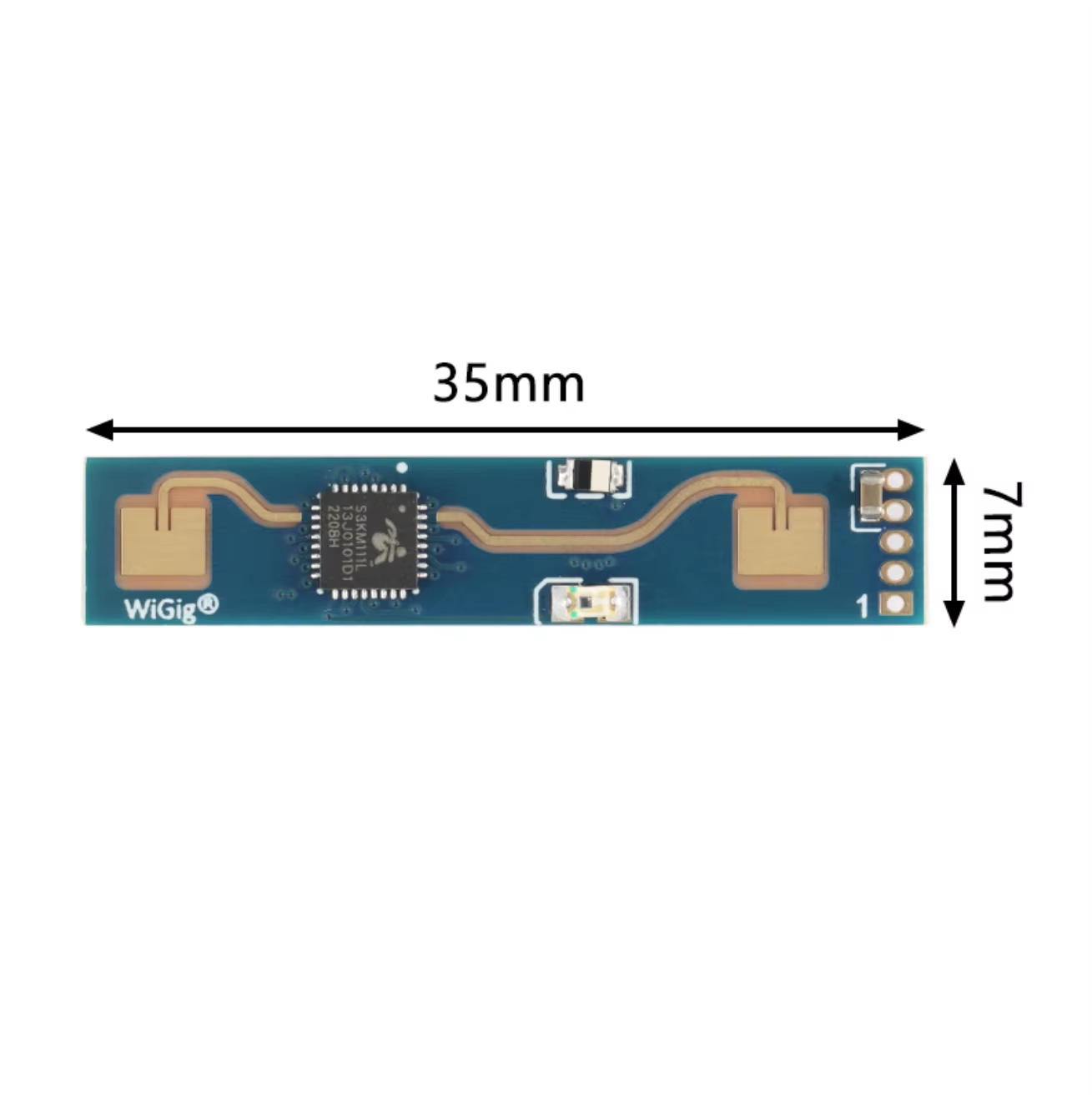
- Compact form factor (around 7 × 35 mm for the radar core module) suitable for ceiling or wall‑mount integration.
Technical Specs (Typical, HLK‑LD2410B‑P)
Exact values may vary slightly; consult your specific datasheet:- Radar Type: 24 GHz FMCW millimeter‑wave human presence radar.
- Detection Range: up to 5 m indoors, with 0.75 m resolution.
- Detection Angle: approx. ±60°.
- Interfaces: OUT (presence), UART_TX, UART_RX, GND, VCC.
- Supply Voltage: 5 V input; recommended supply current ≥ 200 mA.
- Communication:
- UART default 256000 baud.
- Bluetooth for configuration and diagnostics.
- Installation: supports ceiling or wall mounting; best performance when antenna faces open monitored area.
What’s Included
1 × Original HLK‑LD2410B‑P Human Presence Radar Sensor Module (with integrated Bluetooth and UART).
Safety Note
This radar module is intended for indoor human presence detection; avoid installing in locations with continuous non‑human motion (e.g., rotating fans, large moving machinery) to reduce false detections.
-
Ensure the antenna has a clear line of sight to the monitored area; metal enclosures or dense obstacles can attenuate or reflect the radar signal.
When integrating with mains‑powered loads (lights, appliances), always route the radar’s low‑voltage outputs through appropriate isolation and driver circuits (relays, optocouplers, or solid‑state relays) and comply with local electrical safety codes.
Share